




Introduction
How a restaurant chain delivers full-service dining with minimal staff, faster ordering, and a fully digital guest journey.
Free Men is a full-service restaurant concept built around one core idea: deliver restaurant-quality service with minimal staff involvement in the ordering process.
Instead of relying on waiters to take orders and handle payments, Free Men uses Gravy’s digital ordering flow to automate the guest journey from menu browsing to payment and tipping. Guests scan a QR code, place orders from their phones, and pay directly in the flow, while the restaurant team focuses on food delivery and service execution.
This allowed Free Men to create a scalable restaurant model with faster service, leaner staffing, and a more convenient experience for guests.
About the Venue
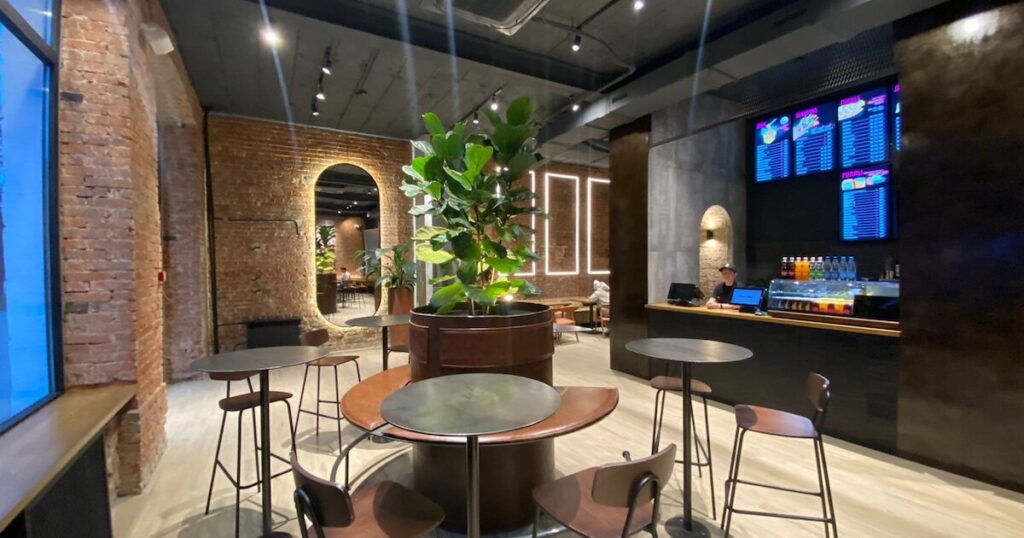
Free Men is a growing full-service restaurant chain currently operating in two locations. Each restaurant is built around the same operational concept: accessible, quality food with restaurant-level service, delivered through a highly optimized service model.
The concept was designed to reduce dependency on large waiter teams while maintaining a strong guest experience. Instead of traditional waiter-led ordering, the restaurants rely on digital ordering and payment, supported by a lean floor team focused mainly on running food to tables.
In addition to dine-in service, the concept also needed to support takeaway orders as part of its operational model.
The Challenge
The Free Men team set out to solve a difficult operational challenge: how to build a full-service restaurant model that remains fast, efficient, and guest-friendly while minimizing staffing needs.
To make the concept work economically, the restaurants needed to reduce labor costs and simplify service processes without compromising quality. At the same time, guests still needed a convenient and intuitive experience that felt smooth and modern rather than stripped down.
The business also needed to support takeaway alongside dine-in service, which added more complexity to order handling and kitchen coordination.
Before implementing Gravy, the team needed a way to:
- reduce dependency on waiters for order-taking
- speed up ordering and payment flow
- support takeaway within the same operational system
- keep menus and orders synchronized with the POS
- maintain reliable performance during peak hours
The goal was not just to digitize menus, but to redesign the restaurant workflow around speed, simplicity, and staff efficiency.
The Gravy Setup
Free Men implemented Gravy as the digital ordering layer across its restaurants.
The setup included:
- QR Menu at every table
- mobile ordering directly from guests’ smartphones
- integrated online payment in the order flow
- built-in digital tipping during checkout
- full POS integration for menu and order synchronization
- support for takeaway orders within the same system
Instead of waiters taking orders, guests scan a QR code, browse the menu, place the order, and pay on their own. Staff are no longer tied up with repetitive order-taking and payment collection, and can focus mainly on delivering dishes and supporting the floor.
How It Works in Practice
- Guests sit down and scan the QR code at the table
- They browse the digital menu on their phone
- They place the order directly in the flow
- They pay online and can add a tip during checkout
- The order is instantly synchronized with the POS
- The kitchen receives the order automatically
- Runners deliver the dishes to the table
This creates a restaurant flow where ordering, payment, and tipping happen digitally, while staff focus on execution rather than transaction handling.
What Changed
After implementing Gravy, Free Men achieved strong results across speed, revenue, and staffing efficiency:
- 50% faster service speed
- order time reduced to around 5 minutes
- 16% higher average check
- 11% increase in total tips
In operational terms, the improvement was substantial. Each restaurant handles up to 150 orders per shift with a relatively small team, while the average restaurant size remains around 30 tables.
The staffing model also changed significantly. Instead of relying on a traditional waiter team, each shift can now operate with only two runners who focus on bringing food to guests. This reduced labor costs and allowed the business to allocate staff more efficiently.
At the same time, the guest experience became faster and more convenient. Customers can browse, order, pay, and track status with minimal delay, while the restaurants maintain consistent performance even during peak demand.
The result is a restaurant model that combines full-service dining with a highly efficient digital operating structure.
“Gravy helped us turn the Free Men concept into a working operational model. Guests order, pay, and even leave tips directly from their phones, while our team stays focused on service and delivery instead of routine order-taking. We serve faster, handle peak hours more confidently, and run each shift with a much leaner team. For us, this was not just a digital menu — it became a core part of how the business works.”
— Operations Manager, Free Men
Why This Setup Worked
This setup works because it removes the most time-consuming and labor-intensive parts of traditional table service without removing service quality itself.
- QR ordering replaces manual order-taking
- online payment removes checkout delays
- digital tipping increases tip participation naturally
- POS sync keeps menus and orders accurate
- a runner-based model simplifies staffing and service execution
Instead of building the operation around waiters, Free Men built it around a digital order flow supported by a lean service team. That made the concept faster, more scalable, and more cost-efficient.
Who This Use Case Is Best For
This model is especially effective for:
- full-service restaurants looking to reduce labor costs
- restaurant groups building lean operational models
- venues with high order volume and limited staffing
- concepts combining dine-in and takeaway
- operators looking to increase speed without sacrificing service quality
If your restaurant depends too heavily on waitstaff for basic order flow, a QR-based service model like this can dramatically improve efficiency while keeping the guest experience strong.
Explore more real-world scenarios in our Use Cases section.

