


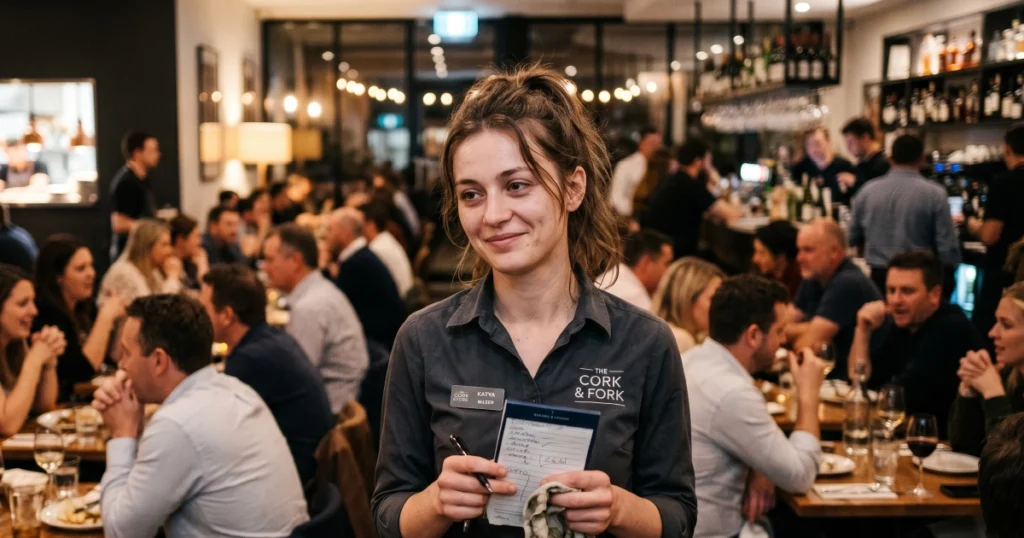

Walk into a busy restaurant during peak hours, and you’ll see the same pattern almost everywhere: a queue forming at the counter, staff moving faster and faster, and guests waiting — not because food takes time, but because ordering does.
This is where most foodservice operations start to break down. Not in the kitchen. Not in the menu. But in the moment where a guest tries to place and pay for an order.
In this guide, we’ll look at why restaurant service slows down during busy hours — and why so many of those problems come back to the same core bottleneck.
The Foodservice Industry Has a System Problem
The foodservice industry is often described as facing multiple challenges:
- labor shortages
- rising operational costs
- increasing guest expectations
- pressure to serve faster without sacrificing quality
All of these are real. But they are not isolated problems — they are symptoms of a deeper issue.
Most restaurant operations are still built around workflows that depend heavily on staff-mediated ordering. That model works when demand is predictable. It breaks when volume increases.
Where Restaurant Service Actually Breaks Down
When a restaurant becomes busy, the failure point is rarely the kitchen. In most cases, the kitchen can handle more orders than it receives.
The real bottleneck happens earlier — at the ordering stage.
- guests wait to place an order
- staff can only process one guest at a time
- orders queue before they even reach the kitchen
- checkout adds another layer of delay
This creates a hidden inefficiency: the restaurant is often limited not by how much food it can produce, but by how quickly it can accept orders.
Why Traditional Ordering No Longer Scales
Traditional ordering models rely on human interaction:
- a guest approaches the counter
- a staff member takes the order
- the order is entered manually into the POS
- payment is processed
This process is linear by design. It works well at low volume — but under pressure, it becomes the slowest part of the entire operation.
Even the best team cannot serve multiple guests at the same time through a single ordering point. As demand grows, queues grow with it.
The Real Cost of Inefficient Ordering
When ordering slows down, the impact goes beyond waiting time.
- guests abandon orders or leave
- table turnover decreases
- staff experience higher stress and burnout
- upselling opportunities are missed
Every minute a guest spends waiting is a minute the business is not generating revenue. Over time, this becomes one of the most expensive inefficiencies in restaurant operations.
Why Adding More Staff Doesn’t Solve the Problem
A common response to high demand is to add more staff at the counter.
In practice, this approach has limits:
- labor costs increase quickly
- space at the counter is limited
- training and coordination become more complex
More importantly, the process itself does not change. It remains linear and dependent on human throughput.
This means the bottleneck is not removed — it is only pushed a little further.
How Digital Ordering Changes the Model
Instead of increasing staff capacity, many restaurants are changing the ordering model itself.
Digital ordering solutions — such as QR-based menus, tablet ordering, and self-service kiosks — remove the dependency on a single ordering point.
Guests can:
- browse the menu on their own
- place orders without waiting
- pay instantly through integrated checkout
Orders are sent directly to the POS system and kitchen without manual re-entry.
This transforms ordering from a linear process into a parallel one — where multiple guests can order at the same time.
From Bottleneck to Flow
When ordering becomes parallel instead of sequential, the entire operation changes.
- queues are reduced or eliminated
- staff focus shifts from order-taking to service
- order throughput increases without adding headcount
- guest experience becomes faster and more predictable
Instead of pushing more people through the same narrow point, restaurants remove the bottleneck altogether.
Why the Industry Is Moving Toward Digital Ordering
The shift toward digital ordering is not just about technology — it is about operational design.
Restaurants are moving toward models where:
- ordering is distributed across multiple channels
- guests choose how they want to interact
- POS systems act as the central hub for all orders
This is why solutions like POS-integrated ordering platforms are becoming essential, not optional.
Where This Bottleneck Shows Up in Real Restaurant Operations
The ordering bottleneck appears differently depending on the type of venue — but the pattern is always the same: demand increases, and the ordering process slows everything down.
- Fast food and QSR: queues build at the counter, limiting how many orders can be processed during peak hours
- Casual dining: guests wait for staff to take orders, delaying both ordering and table turnover
- Food courts and takeaway: a single ordering line becomes the main constraint, even when the kitchen can handle more volume
- High-traffic venues: staff become overloaded with order-taking instead of focusing on preparation and service
In all of these cases, the issue is not the ability to produce food — it is the ability to capture demand efficiently.
Once ordering becomes faster and more accessible, the entire operation becomes more predictable, scalable, and easier to manage.
Conclusion
The foodservice industry does not suffer from a single major problem. It struggles with a structural limitation: ordering does not scale with demand.
As long as restaurants rely on staff-mediated, linear ordering processes, they will continue to face queues, delays, and operational pressure.
The shift toward digital ordering is not about replacing people — it is about removing the moment where the operation slows down.
Want to see how modern restaurants eliminate ordering bottlenecks?
Explore how digital ordering solutions help create faster, more scalable service operations.


