



Restaurants do not invest in digital menus because of features alone. They invest because those tools improve how the business performs.
Digital menus are often introduced as a way to modernize the guest experience. But digital menu ROI depends on much more than appearance alone. It depends on whether the system helps the restaurant reduce costs, increase revenue, and operate more efficiently.
That impact shows up in several areas at once: ordering speed, item visibility, upselling consistency, and staff workload.
Even small improvements in each area can compound over time.
In practice, they are not just a design upgrade. They become part of the economic system of a restaurant.
Why the Menu Is a Financial Lever, Not Just a Design Element
In many restaurants, the menu is still treated as a static layer — something that presents dishes and prices. But in practice, it plays a much bigger role in how the business performs.
The menu affects how quickly guests can browse and decide, how easily they notice higher-margin items, how naturally they add extras, and how often mistakes happen during ordering.
Small inefficiencies at this stage often go unnoticed. But they repeat across every table, every shift, and every day. That is why the menu is not just a design element. It is a financial lever that directly affects revenue, efficiency, and operational flow.
Where Digital Menus Reduce Costs
One of the most immediate effects of digital menus is a reduction in operating overhead.
The most obvious example is printing. Physical menus need to be updated, redesigned, and reprinted whenever prices change, items rotate, or availability shifts. Over time, that creates recurring cost and unnecessary friction.
Digital menus remove most of that overhead. Updates can be made centrally and instantly, without waiting for a new print cycle.
Beyond printing, there is also an operational effect. When menus are clearer, structured, and easier to navigate, guests require less guidance. Staff spend less time answering repetitive questions and correcting avoidable ordering mistakes.
This does not eliminate the need for staff. But it reduces unnecessary load, especially during peak hours, and allows teams to focus on service rather than constant clarification.
Where Digital Menus Increase Revenue
While cost reduction is important, the revenue side is often where digital menus create the most meaningful impact.
The first driver is visibility. A well-structured digital menu makes it easier for guests to discover items, including higher-margin dishes, upgrades, and combinations that might otherwise be overlooked.
Consistency acts as the second driver. Built-in add-ons and upsells allow restaurants to present relevant options every time, without depending on staff to remember or prioritize them during busy service.
The third is speed. When guests can browse and order more efficiently, restaurants can serve demand with less delay. During peak periods, even small improvements in ordering speed can influence overall throughput.
In practical terms, digital menus help restaurants generate more value from the same flow of demand. Even modest improvements in average check size or ordering efficiency can compound over time.
A Simple Way to Think About ROI
Digital menu ROI is often misunderstood as a design improvement. In reality, it is driven by operational and financial impact.
A simple way to think about it is:
ROI = (Revenue lift + Cost savings) – System cost
Revenue lift typically comes from higher average order value and more efficient service during busy periods.
Cost savings come from reduced printing, fewer operational inefficiencies, and better use of staff time.
System cost includes software, any required hardware, and integration with existing workflows.
Individually, each of these factors may seem incremental. But together, they can have a meaningful effect on overall performance.
What This Looks Like in Practice
Consider a mid-sized restaurant with steady traffic throughout the week.
If the menu becomes easier to navigate, guests make decisions faster. When relevant add-ons are presented consistently, average order value increases slightly. Fewer questions and corrections also allow staff to operate more efficiently during peak hours.
For example, if average order value rises slightly, ordering delays shrink during peak periods, and menu updates no longer require reprinting, the combined impact can become meaningful within a relatively short time.
None of these changes need to be dramatic to matter. Even small improvements, applied consistently across hundreds of orders, can translate into noticeable gains over time.
The impact is not always immediate or obvious in a single shift. But over weeks and months, it becomes visible in both revenue and operational stability.
When the ROI Is Strongest
This model can create value in many types of restaurants, but the financial impact tends to be strongest in certain conditions.
- high-traffic environments with peak-hour congestion
- menus with many items, modifiers, or combinations
- operations where upselling is currently inconsistent
- venues where guests experience delays in browsing or ordering
- restaurants that update menus frequently
In these environments, even small improvements in speed, clarity, and consistency can have a disproportionate effect on performance.
Why Standalone Tools Usually Underperform
Many restaurants adopt digital tools in a fragmented way — one system for menus, another for ordering, a separate provider for payments, and only partial connection to the POS.
This often creates new complexity instead of reducing it. Multiple vendors, disconnected workflows, and inconsistent data can limit the overall impact of each individual tool.
In these setups, the menu may improve visually, but the broader operation does not improve as much as it could.
As a result, the expected return on investment is often lower than it should be.
In practice, fragmented setups often reduce the very ROI they are supposed to create, because operational gains in one part of the journey are lost in another.
Digital Menus Work Best as Part of an Integrated System
A digital menu delivers the most value when it is connected to the rest of the restaurant’s workflow.
When ordering, payments, and POS processes are aligned, the system becomes more than a set of separate tools. It becomes a coordinated environment where each part supports the others.
This includes:
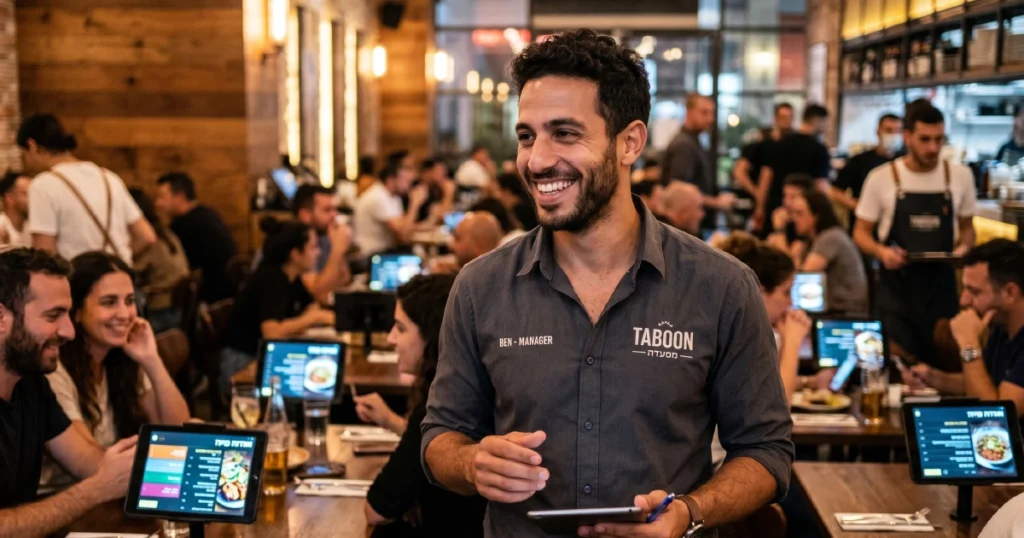
- QR-based ordering at the table
- tablet-based browsing and ordering
- self-service ordering points
- POS-connected order processing
- integrated upselling logic
On their own, these tools improve individual parts of the experience. Together, they improve how the entire operation performs.
The real value does not come from the menu alone. Instead, it comes from how the menu connects to ordering, payments, POS workflows, and the broader service flow.
Conclusion
Digital menus are often introduced as a way to improve the guest experience. But their long-term value is economic.
They reduce unnecessary overhead, improve consistency, and create more opportunities to capture value within the existing flow of demand.
When implemented as part of an integrated system, they move beyond presentation and become a tool for improving how the restaurant operates as a whole.
That is why digital menu ROI is not just about replacing print with screens. It is about turning the menu into a system that actively drives performance.
Want to see how integrated digital ordering works in real restaurant environments?
Explore how QR menus, tablets, and kiosks connect with POS workflows to improve performance.


